Zero Emission Corridor Launched in Frankfurt: What Is Slovenia’s Role?
Nextistence in the Media
Source of information and full article – author Nataša Koražija, Finance:
https://www.finance.si/okolje-%26-energija/v-frankfurtu-so-zagnali-zero-emission-corridor-kaksna-je-vloga-slovenije/a/9041343
What Exactly Is the Zero Emission Corridor (ZEC) Project Launched in Frankfurt?
Matjaž Logar from the Nextistence Institute helped explain what the Zero Emission Corridor (ZEC) project is and what it represents. Together with Simon Ferjuc from Tetida Power to X and other members of the delegation, he attended the GEO Forum in Frankfurt, where the ZEC project was officially launched.
Main Objectives of the Project
The main goals of the ZEC project are the decarbonization of transport, improvement of air quality, and encouragement of the transition to zero-emission vehicles in road, maritime, and rail transport.
To achieve these goals, it is necessary to establish the required infrastructure – a network of electric and hydrogen charging stations. The project also aims to create testing zones for new technologies and to build a supportive regulatory environment for zero-emission transport. Another important objective is to strengthen energy sovereignty.
Five Partners in the Consortium
ZEC is a project of five consortium partners: Tetida Power to X, a Croatian company specializing in hydrogen technologies, KWVD, the Croatian Business Association in Germany, Leonitus, a Croatian investment company, Nextistence Institute, Slovenia, led by Matjaž Logar and Gvido Omladič.
“The idea for a zero-emission corridor emerged from the needs we identified while implementing previous hydrogen technology projects. The main challenges are the still underdeveloped market for green hydrogen consumption and the difficulties of large-scale hydrogen transport. Although the potential demand for green hydrogen in logistics and especially industry is very high, the market still needs to be built,” explains Matjaž Logar. At present, areas with strong potential for affordable green hydrogen production are geographically different from the locations of industry and logistics, which are expected to be the largest users of green hydrogen. “From this need, the concept of ZEC was born. It is a transport-industrial initiative connecting the Mediterranean and the Baltic Sea,” says Logar.
The Baltic-Adriatic corridor is one of the nine core European TEN-T corridors.
The objective of the European Green Deal is climate neutrality for the EU by 2050 and includes a comprehensive transformation of European energy and transport policies.
Through the ZEC corridor, green hydrogen is connected with Europe’s strategic goals, contributing to the implementation of TEN-T objectives and the AFIR regulation (Alternative Fuels Infrastructure Regulation).
Building Refueling Stations Every 200 Kilometres
The project is focused on realistic and practical goals. Among them is infrastructure development in line with AFIR requirements. The plan includes the strategic placement of hydrogen refueling stations every 200 kilometres along the corridor. This will ensure smooth and efficient hydrogen transit transport.
A Testing Ground for New Technologies
At the same time, ZEC will function as a testing ground for new technologies, operational models, and regulatory frameworks related to the use of hydrogen in transport, industry, and cities.
One such pilot project is being developed in Novalja, Croatia, where a hydrogen production facility powered by sea wave energy is already under construction. The project also promotes the use of hydrogen vehicles across multiple segments, including public transport, municipal vehicles, trains, and vessels, with the goal of reducing air pollution in cities and throughout the corridor.
ZEC supports the use of green hydrogen produced from renewable sources such as solar power plants, wind turbines, wave energy, hydropower, and hydrogen from waste using geothermal resources.
In this way, the project supports a faster and more efficient transition to green transport on major European corridors.
Project Timeline
The first project within the Zero Emission Corridor began on 11 January 2023, when the Mayor of Novalja, Ivan Dabo, and representatives of the Zero Emission Corridor project team, Kruno Fafandel and Simon Ferjuc from Tetida Power to X and Leonitus, signed an agreement for the pilot project of energy self-sufficiency for the city of Novalja.
At that time, the Nextistence Institute joined the initiative and organized a thematic hydrogen technology conference in Slovenia in June 2023.
New Members of the Initiative
The project gained additional momentum when the project partners secured funding through the I3 (Interregional Innovation Investments) instrument for the NACHIP project and began implementation. In September 2024, the Croatian company DOK-ING (later DOK-ING Energo), developer of hydrogen gasification technology, joined the initiative.
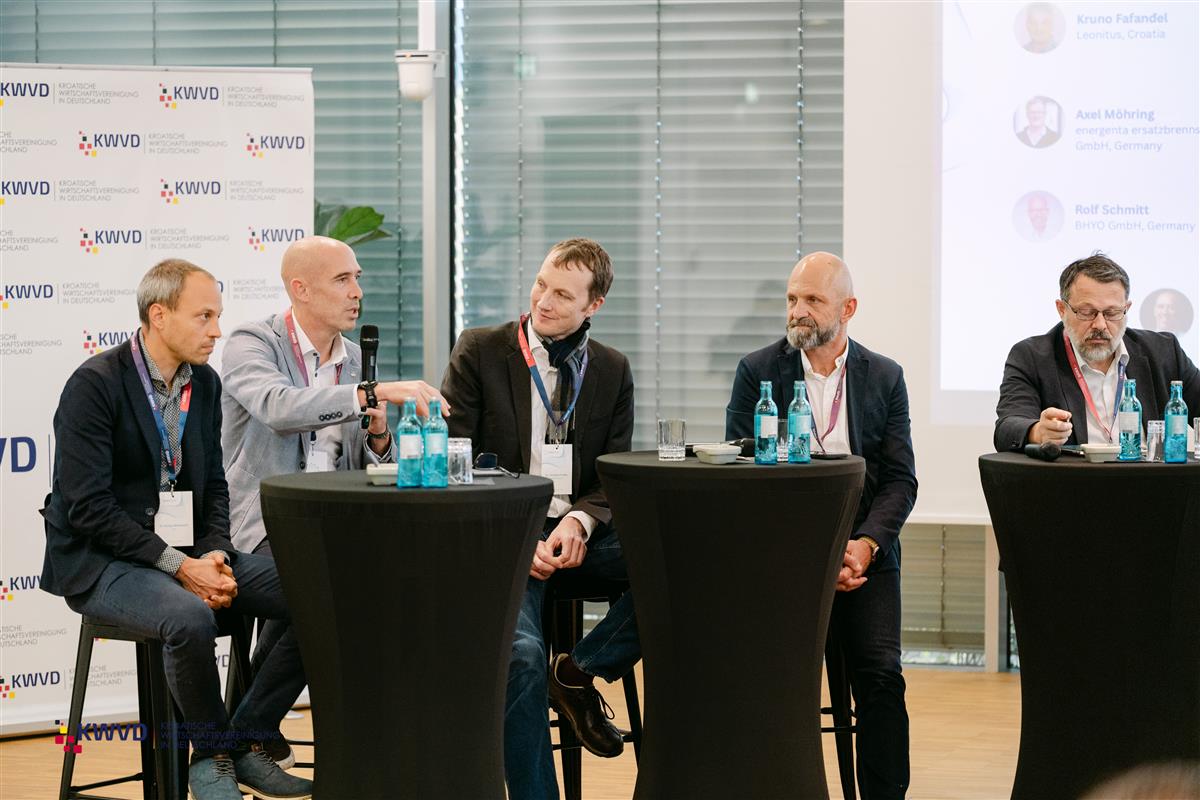
This autumn, the GEO Forum 2025 conference was organized in Frankfurt, where KWVD, the Croatian Business Association in Germany, and the company Pelagus also joined the project.
In the future, the partners aim to strengthen the initiative further with representatives from Austria and Hungary.
So far, the projects have been financed through the partners’ own resources, together with funds obtained from the I3 programme and the NACHIP project. The Zero Emission Corridor itself is currently financed by its members.
Project in Novalja
The pilot project in the Port of Žigljen in the Municipality of Novalja – set to become the first city on the Zero Emission Corridor – is progressing rapidly, according to ZEC representatives.
Wave-powered electricity generation devices are currently being installed. In the next phase, green hydrogen production and distribution will be established in the Novalja area through a facility with a planned capacity of 1 MW. Production is expected to begin by 2027, while full energy self-sufficiency for the city of Novalja is planned by 2030.
Participants at the GEO Forum in Frankfurt
Participants included Mario Šušak (President of KWVD), Dubravka Šuica (European Commissioner for the Mediterranean), Jorgo Chatzimarkakis (CEO of Hydrogen Europe), Christian Haas (CoDiVe Institute), Birgit Scheppat (Hochschule RheinMain), Peter Birkner (House of Energy), Ivan Dabo (Mayor of Novalja), Uroš Salobir (ELES), Thomas Neuenhahn (Siemens Energy), Marius Schäfer (Hessen Entrepreneurs Association), Filip Stojmenović (DOK-ING Energo), Mario Perić (Končar Elektroindustrija), Dinko Đurđević (Green Sustainable Solutions), Elias Spreitner (Ministry of Economy of Hessen), and Alexander Labermeier (Federal State of Hessen).